Dexterous manipulation policies today largely assume
fixed hand designs, severely restricting their generalization
to new embodiments with varied kinematic and structural layouts.
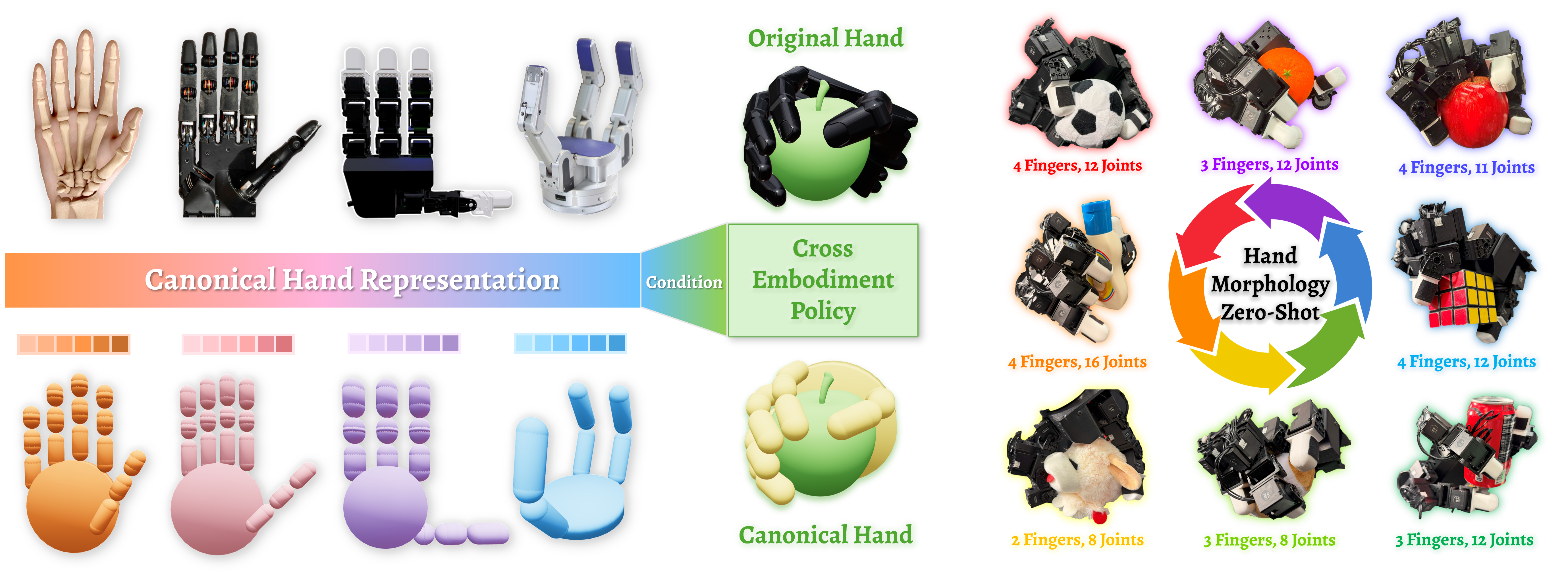
To overcome this limitation, we introduce a parameterized
canonical representation that unifies a broad spectrum of dexterous
hand architectures. It comprises a unified parameter space
and a canonical URDF format, offering three key advantages. 1)
The parameter space captures essential morphological and kinematic
variations for effective conditioning in learning algorithms.
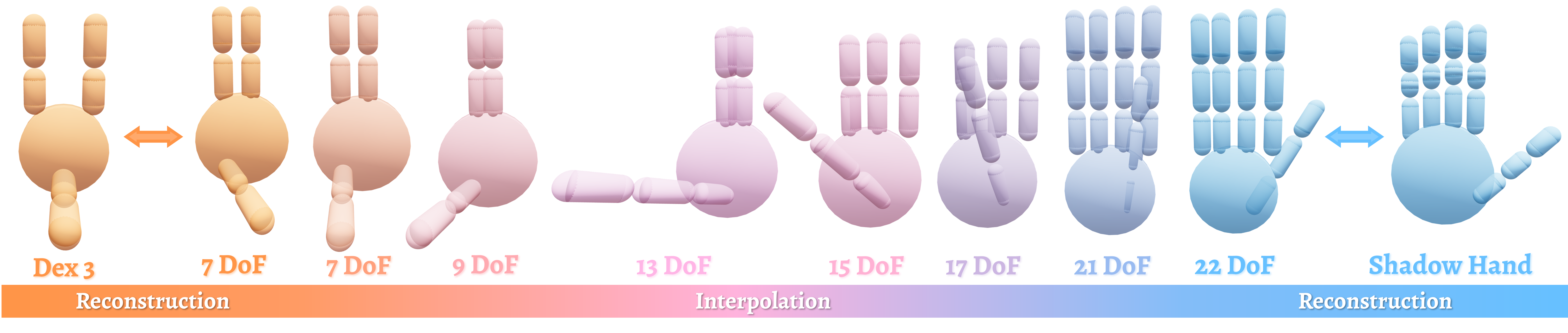
2) A structured latent manifold can be learned over our space,
where interpolations between embodiments yield smooth and
physically meaningful morphology transitions. 3) The canonical
URDF standardizes the action space while preserving dynamic
and functional properties of the original URDFs, enabling efficient
and reliable cross-embodiment policy learning.
We validate these advantages through extensive analysis and
experiments, including grasp policy replay, VAE latent encoding,
and cross-embodiment zero-shot transfer. Specifically, we train
a VAE on the unified representation to obtain a compact,
semantically rich latent embedding, and develop a grasping policy
conditioned on the canonical representation that generalizes
across dexterous hands. We demonstrate, through simulation
and real-world tasks on unseen morphologies (e.g., 81.9% zeroshot
success rate on 3-finger LEAP Hand), that our framework
unifies both the representational and action spaces of structurally
diverse hands, providing a scalable foundation for cross-hand
learning toward universal dexterous manipulation.